

So your partner has an eating disorder.
Actually, hey, let’s not narrow our focus too much. Your partner has issues with food. Maybe they’re a chronic dieter looking to get off that rollercoaster. Maybe they technically consume enough calories in a day, but are themselves consumed with fears and concerns about their appearance, their health, their weight, etc. That’s normal, unfortunately. I suspect that in the 21st century western world, that’s almost unavoidable. If you did avoid it, please tell me your secrets.
Because the sources are so diffuse and pervasive, it’s hard to point to one singular “why.” The reasons we eat the things we eat, the way that we eat them, are complicated and deep. But let’s just accept as a given that we can’t know the precise reason it started. Fine, cool. We can still identify what’s feeding it. And I have just the tool for that.
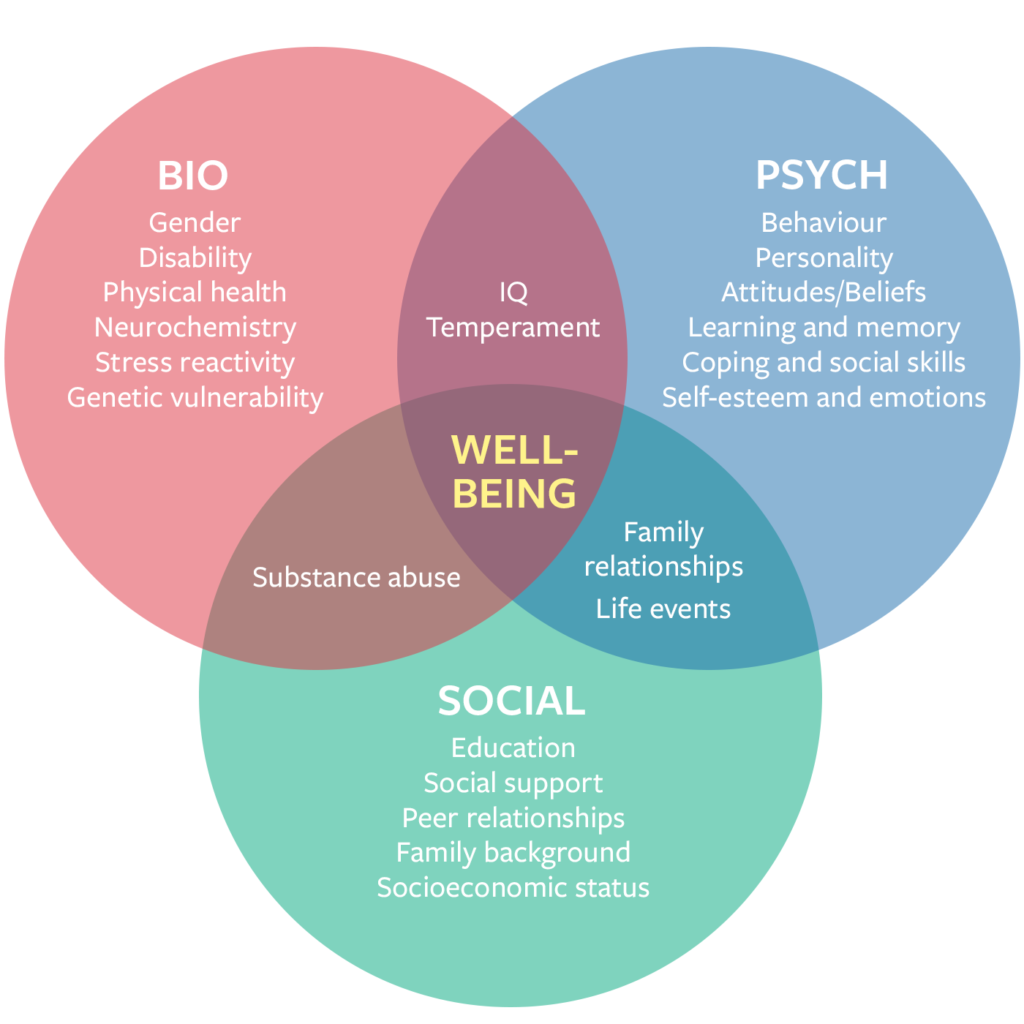
The Biopsychosocial Model
I personally believe in the Bio-psycho-social model, which holds biological, psychological, and sociological sources of the disease to be equally valid. You have to resist the urge to jump straight to the biological explanations, even though that can seem easy and obvious. If you do that, you are missing all of the cultural cues, psychological triggers, and social relationships that could also contribute. Don’t do that. Don’t be that guy.
Biological
But let’s talk about what the biological does contribute to the conversation. Some people may inherit brains that process dopamine just a little differently. Maybe they feel fullness in a different way than you or me. Maybe their digestion responds more or less sensitively to anxiety. Use your imagination, but anything physiological could be a contributor here.
Let’s ground it with an example. When I am severely anxious, I sincerely have incredible difficulty eating. My throat closes up, and if I try to force food down, I may choke, gag or vomit. The whole thing is awful and uncomfortable and is tied to a family history of acid reflux. At the most tense points in my life, I have been unable to eat much of anything for stretches of weeks. If social pressures had hit me just a little differently, or if my psychological profile was different, this might have caught traction and become an eating disorder instead of an unhappy inconvenience.
Psychological
The Psychological side of things involves the person’s behaviors, attitudes, fears, habits, skills, beliefs, self esteem, and emotions, among other things. For example, if a person is unimaginably stressed all the time, they will be in a constant fight-or-flight mode. That’s a different headspace, and it affects the way that decisions are made. We can talk about background noise here, or the front-of-mind cognitive topography of a person’s experience.
Example time: being a minority or an oppressed group can wear you down real hard. I think we can all imagine that our self-esteem would be a lot more fragile if everyone in the world seemed to be judging us, staring at us, pressuring us to be something we are not. If nobody we see on TV looks like us, stands up for us. That’s a background noise in your head that could pre-dispose you to tip over into an eating disorder. Or maybe you believe that your body is where your value is located, that your appearance is a key part of your identity. Shoot, let’s not even get started on the lasting effects of trauma on the body and the mind. These are potential psychological sources of eating disorders (and a bunch of other stuff, but let’s stay focused).
Social
This is the one that can be hardest for us to accept, because it may require us to take some responsibility. The social factors include things like the ammount of support one feels they have, the general environment, their peer relationships, their personal education and the education of those around them, and so on.
A person who feels unsupported and undervalued might want to make themselves small and unobtrusive. Or think they have to conform to ridiculous standards of beauty to earn the support they lack. If school is super intense, it can create a strong pressure to confrom and perform, which may come out in a person’s eating habits or beliefs about their body. If their peers or family members are afraid of gaining weight, or have strong food rules, that can send a message that nudges a person in the wrong direction. Combine that with the other two, and you have a “perfect storm” that can lead to an eating disorder, or at least disordered forms of eating.
This can seem overwhelming, but I believe that it gives us a roadmap to the solutions that will work for you and your partner. We’re going to use this framework to map out the things that are feeding the disorder, and then cut that shit out of our lives, one problem at a time.
First, start by talking with your partner. Brainstorm. Go deep and hard into your childhoods, your lives, your feelings, your fears, your needs. If you want, this can be a great place to add a couples therapist to the equation. Remember to explore the biological, psychological, and social factors with equal vigor. Everybody’s experiences are different and some factors may be more relevant than others, but none should be ignored.
Then (and this part should be obvious by now), address what comes up.
This is not going to be quick or easy. Shoot, we are still figuring this stuff out, and I will likely still be rooting out strange beliefs and misconceptions tucked in the corners of my brain for many many years to come. And that’s ok. As far as I’m concerned, that’s what it means to be a supportive partner.